


Holy Orders
From the earliest days of Christianity, the Apostles appointed men to lead and serve the growing Christian communities. As the Church developed, these ministries took shape in three distinct orders: bishops, priests, and deacons.
Bishops succeeded the Apostles as shepherds of the Church, while priests, also known as presbyters, served as their coworkers in caring for the faithful. The word presbyter comes from the Greek word presbyteros, meaning “elder.” This eventually passed into Latin as presbyter and into Old English as preost, from which we get our English word “priest.” The German word Priester shares the same origin.
The Apostles also appointed seven men to assist with the needs of the growing Christian community, particularly to ensure that widows were not neglected in the daily distribution of food (Acts 6:1–6). This event is traditionally understood as an early foundation of the diaconate. The Greek word diákonos means “servant” or “minister,” and this is where we get the word “deacon.” Deacons are ordained to serve the Church through the proclamation of the Gospel, assisting in the liturgy, and works of charity.
The handing on of the Apostles’ mission and authority to their successors, the bishops, through the laying on of hands is known as Apostolic Succession.
Through this succession, the Church continues the mission entrusted to the Apostles by Jesus Christ.
This apostolic ministry continues today through the Sacrament of Holy Orders, which has three degrees: bishop, priest, and deacon. Holy Orders gives those ordained a special grace to serve as instruments of Christ, bringing people closer to God through preaching, shepherding, worship, and charitable service, according to their particular ministry. The more an ordained minister opens himself to God’s grace, the more faithfully he can reflect the presence and love of Christ to those he serves.
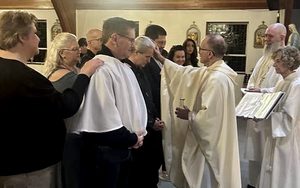
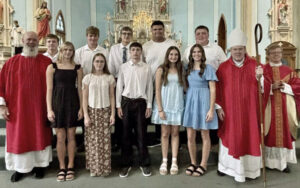
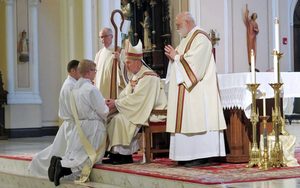
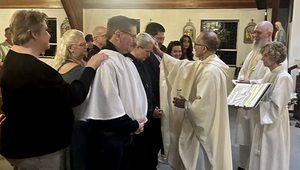
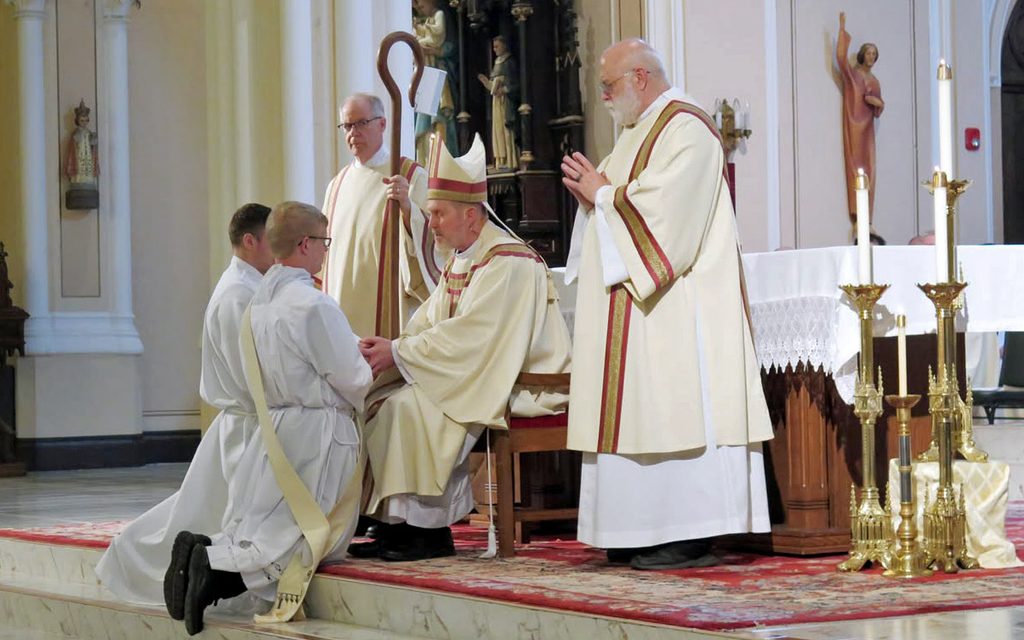
The essential outward sign of Holy Orders is the bishop’s laying on of hands and the consecratory prayer, which calls upon the Holy Spirit to strengthen the newly ordained for his ministry.
Sacred Chrism is also used during the ordination of bishops and priests, although not deacons. The bishop’s head or the priest’s hands are anointed with chrism, symbolizing their special consecration and the gift of the Holy Spirit. Sacred Chrism is also used in Baptism, Confirmation, and the dedication of churches and altars. It symbolizes consecration, the presence and gifts of the Holy Spirit, and being set apart for God’s service.
If you or someone you know is wondering whether Holy Orders might be the vocation you are called to by God, please talk to us, and also learn more at the Diocese of Davenport’s page about discerning vocations.